
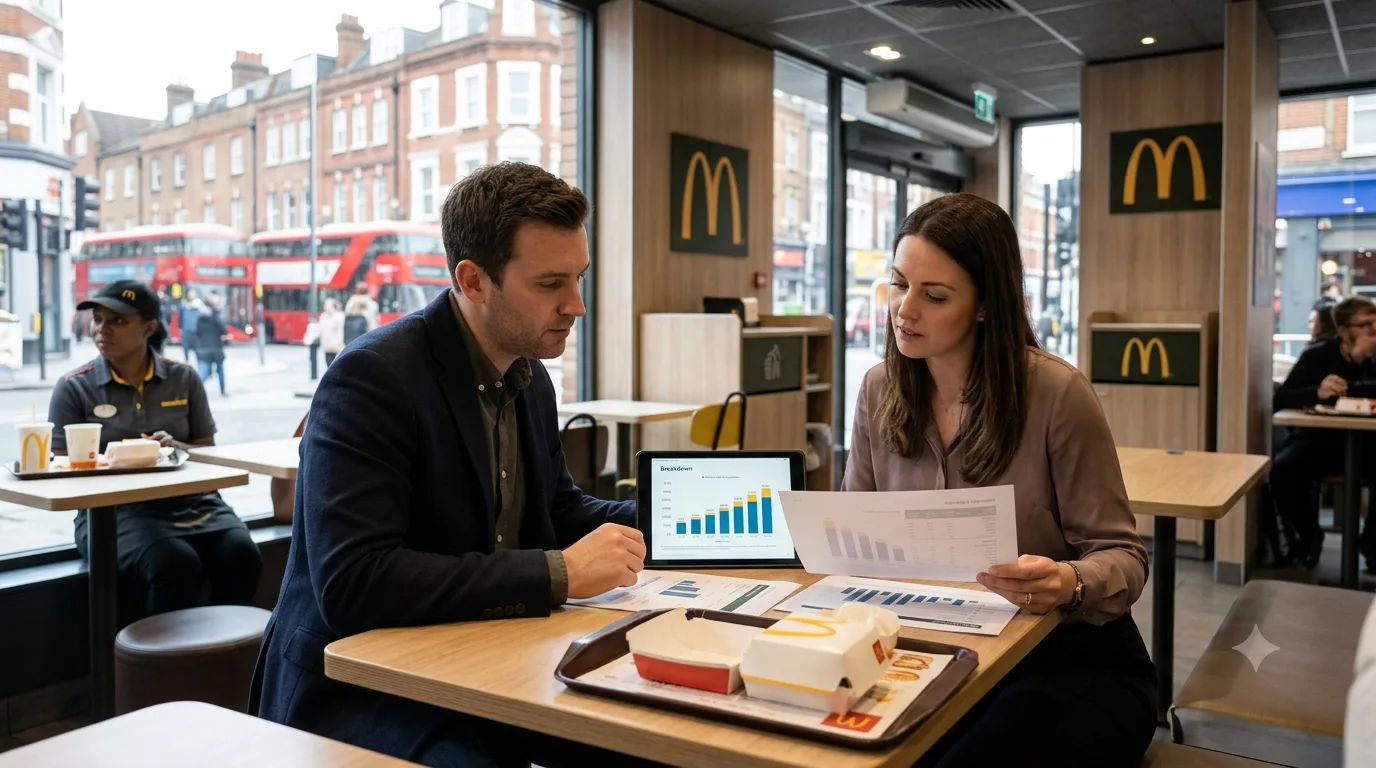
McDonald’s Franchise Cost: A Full UK Breakdown

Buying a McDonald’s franchise in the UK is a substantial investment, but the current cost is clearer than many older estimates suggest.
According to McDonald’s UK’s latest published financial information, restaurants franchised during 2025 required between £900,000 and £1.5 million to purchase the franchise rights and equipment.
Prospective franchisees typically need around £300,000 in unencumbered funds, with at least 25% of the total investment coming from their own available capital.
The remaining investment may potentially be financed through a bank, subject to approval.For serious prospective owners, however, the McDonald’s franchise cost is only one part of the decision.
Rent, royalties, marketing contributions, borrowing costs, staffing, tax and future reinvestment all influence how attractive the opportunity ultimately becomes.
How Much Does a McDonald’s Franchise Cost in the UK?
The best current figure to work from is £900,000 to £1.5 million for the rights and equipment associated with a first restaurant.
This is based on restaurants franchised during 2025 and replaces older estimates that broke the investment into speculative construction, signage, renovation and initial stock costs.
| Financial Measure | Current McDonald’s UK Figure |
| Franchise rights and equipment | £900,000–£1.5 million |
| Typical minimum unencumbered funds | Circa £300,000 |
| Minimum own-funds contribution | 25% of total investment |
| Potential bank-funded proportion | Up to 75%, subject to approval |
| Typical annual sales | £2.0m–£5.8m |
| Monthly royalty | 5% of net sales |
| Marketing contribution | 4.3% of net sales |
| Typical rent | 8%–18% of net sales |
| Typical annual cash flow after year one | £120,000–£400,000 |
| Modelled ROI over 20 years | 20%–25% annually |
McDonald’s says 80% of its UK franchised restaurants recorded annual sales between £2 million and £5.8 million from January to December 2025. These are sales figures rather than profit figures, so they should not be interpreted as the amount an owner personally earns.
What Are You Actually Buying for £900,000 to £1.5 Million?
A common misconception is that a first-time McDonald’s franchisee simply finds a site, builds a restaurant and pays a conventional franchise fee.
That is not how McDonald’s currently describes its UK model.The company says new owners generally start with an established trading restaurant.
Franchisees purchase equipment and the rights to operate that restaurant for the franchise term rather than independently sourcing property and constructing a new McDonald’s from scratch.
The value of restaurants franchised in 2025 was calculated using projected future cash flow and profitability over a ten-year period.
This is important because the £900,000–£1.5 million range should not be treated as a conventional building budget.
A stronger existing restaurant may command a different valuation from another location because the underlying sales and profitability expectations are different.
There Are Two Routes to McDonald’s Restaurant Ownership
McDonald’s now explicitly states that an opportunity can arise in two ways:
- A direct purchase from McDonald’s
- A purchase through an existing McDonald’s franchisee
In both cases, the candidate still has to satisfy McDonald’s selection requirements.
Buying through an existing franchisee should not be confused with purchasing an unrestricted independent restaurant.
McDonald’s must approve franchisees, and its UK FAQ states that an owner who wishes to sell the remaining franchise term can sell it to a McDonald’s-approved buyer.
What About a New-Build McDonald’s?
For an individual applying to become a first-time UK franchisee, budgeting as though they will buy land and independently develop a brand-new restaurant is misleading.
McDonald’s says property selection and franchisee selection are separate processes and that new franchisees take on existing trading restaurants. Applicants therefore do not normally need to source their own property.
That distinction makes the current official £900,000–£1.5 million range considerably more useful than older online estimates combining land, construction and fit-out assumptions.
How Much Money Do You Personally Need?
McDonald’s states that the minimum financial requirement is 25% of the total investment in unencumbered funds, while people interested in becoming franchisees should typically have around £300,000 available.
Unencumbered funds essentially means capital that is genuinely available to invest rather than money that itself depends on additional borrowing or security.
For example:
| Restaurant Investment | 25% Contribution |
| £900,000 | £225,000 |
| £1,000,000 | £250,000 |
| £1,200,000 | £300,000 |
| £1,500,000 | £375,000 |
The £300,000 figure should therefore be viewed as the typical minimum position rather than an assurance that every restaurant can be purchased with exactly £300,000.
Can You Apply With Less Than £300,000?
Potentially.
This is one of the most useful changes in McDonald’s current guidance. Although approximately £300,000 remains its standard minimum, McDonald’s says it is prepared to have an initial conversation with candidates who do not currently meet that level.
Individual experience, financial circumstances and future potential may be considered, and alternative financial arrangements may be available in certain circumstances at McDonald’s discretion.
That does not mean the minimum has disappeared. Applicants should not assume that having substantially less capital guarantees access to alternative funding.
How Can You Finance the Remaining Investment?
McDonald’s says the remaining 75% may be financed through a bank, subject to lender approval.
It also maintains long-standing relationships with established banks that can provide franchisees with finance and competitive terms.
McDonald’s does not currently identify those relationship banks publicly on its financial information page, so applicants should avoid assuming that any particular lender is an official McDonald’s finance partner.
A financing package might therefore consist of:
- Personal unencumbered capital
- Commercial bank borrowing
- Secured business finance where appropriate
- Asset or equipment-related funding where compatible with the transaction and
- Additional capital reserves for personal and business contingencies.
Anyone comparing wider lending options can also examine the different forms of business loans for startup companies before speaking to a lender or financial adviser.
Could a Government Start Up Loan Fund a McDonald’s Franchise?
Not by itself.
The government-backed Start Up Loans programme currently allows an eligible individual to borrow between £500 and £25,000. The programme can therefore be useful for relatively small businesses, but its lending limit is tiny compared with a McDonald’s acquisition approaching £1 million or more.
It should not be presented as a realistic substitute for the substantial personal capital and commercial finance normally required for this franchise.
What Ongoing Fees Does a McDonald’s Franchisee Pay?
The purchase price is only the beginning. McDonald’s identifies three major recurring charges rent, royalty and marketing contributions.
Rent: Typically 8% to 18% of Net Sales
For 80% of restaurants franchised between January and December 2025, monthly rent ranged between 8% and 18% of net sales.
Importantly, McDonald’s says this rent is typically fixed for 20 years on the initial term. Rent is calculated using projected sales and profitability over a ten-year period.
That provides more visibility over the contractual rent structure than a business operating under a short commercial lease, although the actual cash amount paid will still reflect the agreed arrangement.
Royalty: 5% of Net Sales
A franchisee pays an additional monthly royalty equal to 5% of net sales for use of the McDonald’s system.
Marketing Fund: 4.3% of Net Sales
The current marketing contribution is 4.3% of net sales.
Before labour, food, utilities, maintenance and financing costs are considered, the franchise therefore has substantial percentage-based commitments attached to its sales.
That makes margin control particularly important.
How Much Revenue and Cash Flow Can a McDonald’s Franchise Generate?
McDonald’s publishes unusually useful performance ranges for its UK franchise system.
During 2025, 80% of UK franchised restaurants generated annual sales between £2 million and £5.8 million.
After the first year, McDonald’s reports typical annual cash flow of:
£120,000 to £400,000
However, cash flow is not the same as personal income or accounting profit.
McDonald’s defines this figure as the money remaining in the business before the franchisee has taken a personal draw and before outstanding loans or tax payments are paid.
A buyer financing a large proportion of the acquisition could therefore have significant debt servicing to deduct from this amount.
What Does the 20% to 25% ROI Figure Mean?
McDonald’s models the potential annual return on investment at approximately 20% to 25% over the 20-year term.
Again, this is not a guaranteed investment return.
The company specifically notes that actual ROI varies according to future business performance and how individual restaurants are operated. The calculation also does not include all future investments the franchisee may need to make during the 20-year period.
Potential owners should consequently stress-test their own financial model rather than simply applying a 25% return to the purchase price.
A sensible forecast would examine:
- Debt repayments and interest
- Payroll and employer costs
- Food and packaging costs
- Utilities
- Maintenance and equipment replacement
- Insurance
- Tax
- Required reinvestment
- Weaker-than-expected sales and
- The owner’s required personal income.
Does McDonald’s Franchise Cost More in London?
There is no official McDonald’s UK table setting a different franchise purchase range for London, Scotland, northern England or other regions.
It would therefore be misleading to invent regional price bands.
Location can still affect restaurant economics significantly. Customer volumes, trading hours, staffing costs, local competition, delivery demand and expected profitability may all differ between locations.
Because McDonald’s says restaurant purchase values and rent are influenced by projected sales and profitability, these local characteristics can ultimately affect the economics of a particular opportunity.
The key point is that applicants should analyse the individual restaurant being offered, rather than assuming every location within a region carries the same valuation.
What Legal Structure Can a McDonald’s Franchise Use?
McDonald’s offers its UK franchise to one individual, rather than to a conventional business partnership.
Its current FAQ says a franchisee can choose to trade as either:
- A sole trader
- A limited company.
If a limited company is used, McDonald’s states that up to 25% of its shares may be issued to the franchisee’s spouse or civil partner.
This means applicants should not assume that a standard partnership or LLP structure will automatically be accepted simply because those structures are available elsewhere in UK business.
Independent legal and tax advice is sensible before choosing the final structure or signing the franchise documentation.
What About VAT and Tax?
The compulsory VAT registration threshold is currently £90,000 of taxable turnover.
Given McDonald’s published restaurant sales figures of £2 million to £5.8 million, VAT administration will clearly form part of the accounting obligations of a typical restaurant, although the VAT treatment of individual food and drink sales can vary.
An experienced accountant should therefore be involved before the transaction completes.Tax should also be included when evaluating the published £120,000–£400,000 cash-flow figure because McDonald’s states that its figure is before outstanding tax payments.
How Long Does the McDonald’s Application Process Take?
McDonald’s currently states that its selection process takes approximately four to six months.
The process consists of:
- Attend a Franchising Event: Prospective owners first learn more about the business, culture, financial commitment and expectations.
- Submit an Application: Candidates explain their leadership background, experience, motivation and readiness to become a restaurant owner.
- Attend a First Meeting: McDonald’s explores the applicant’s suitability and reasons for wanting to join the system.
- Complete Five Days of Restaurant Experience: Candidates work within an established restaurant for five days to see how the operation functions in practice.
- Attend a Second Meeting: The applicant meets senior management and the Head of Franchising to discuss suitability and their restaurant experience.
- Complete a Psychometric Assessment: Successful applicants undertake an assessment ahead of the final panel stage.
- Attend the Panel Meeting: The final selection meeting involves three senior Vice Presidents.
- Begin Training: Candidates who pass the panel stage enter McDonald’s structured franchise training programme.
- Receive an Offer and Complete the Handover: During training, successful candidates receive an offer for a restaurant. Once the agreement is signed and the acquisition completed, control of day-to-day operations is handed over.
McDonald’s current material does not publish a fixed nine-month training duration, so prospective owners should avoid relying on older claims that training always takes exactly that length of time.
Is a McDonald’s Franchise a Passive Investment?
No.
McDonald’s is explicit that restaurant ownership is hands-on and should be the franchisee’s sole business focus.
Its FAQ states that the franchisee is expected to participate fully in the day-to-day running of the operation rather than simply hiring a manager and treating the restaurant as a passive investment.
That requirement matters when assessing the return.A McDonald’s franchise involves both substantial capital and significant personal involvement.
Can You Own More Than One McDonald’s Restaurant?
Yes, but new franchisees normally begin with one restaurant.
Additional restaurants are earned through performance rather than guaranteed at the start. McDonald’s says franchisees who consistently achieve strong standards may be offered opportunities to operate more locations.
Its current franchise material positions restaurant ownership as a route towards building a multi-site portfolio.
Many owners eventually operate five, ten or more restaurants, but expansion depends on sustained performance, leadership capability and the development of management teams that can support a larger operation.
For investors with multi-unit ambitions, this changes the financial planning considerably. Capital should not be committed to the first restaurant on the assumption that additional sites will automatically follow.
How Does McDonald’s Compare With Other UK Food Franchises?
McDonald’s sits towards the high-capital end of UK food franchising.
For perspective, Subway’s UK material published in 2026 indicates an approximate total investment of £85,000 to £220,000, with a £13,000 franchise fee, £100,000 of liquid assets and a £150,000 net-worth expectation. Its ongoing royalty is 8% alongside a 4.5% advertising contribution.
KFC presents a very different profile. Its UK development team currently states that prospective franchisees require £5 million in assets and £2 million in liquid funds, alongside previous food-and-beverage operating experience.
KFC also states that it is not currently looking for new franchise partners, highlighting how availability can be just as important as headline cost.
Investors researching alternatives can compare McDonald’s with the business models and entry costs surrounding a Wingstop franchise, Cake Box franchise or the more selective Greggs franchise and partnership model.
The cheapest franchise is not automatically the better investment. Capital requirements, franchise availability, owner involvement, restaurant sales, ongoing fees and expansion potential all need to be considered together.
What Are the Main Risks of Buying a McDonald’s Franchise?
Brand recognition does not eliminate business risk.
A prospective owner should consider several issues before committing:
- High initial investment: Even the lower end of the current range approaches £1 million.
- Debt exposure: Funding up to 75% through borrowing can produce substantial repayments and interest costs.
- Percentage-based charges: Rent, royalty and marketing contributions take a share of sales before many other operating expenses are considered.
- Operational pressure: A high-volume restaurant requires strong recruitment, staff development, cost control and day-to-day leadership.
- Long commitment: McDonald’s describes the opportunity as a 20-year business relationship.
- Future investment: The published ROI estimate specifically excludes future investment that may be necessary during the term.
- Performance variation: Sales, cash flow and ROI figures are historical or modelled ranges, not guarantees.
For that reason, applicants should review the individual restaurant’s historic trading information, expected investment needs, finance terms and contractual obligations with professional advisers before proceeding.
Is a McDonald’s Franchise Worth the Investment?
For the right operator, the economics can be compelling.
An established brand, existing trading restaurant, structured training, banking relationships and a potential path towards multi-unit ownership remove some of the uncertainties involved in creating a restaurant concept from nothing.
At the same time, this is not a low-cost or passive franchise.
An investment of £900,000 to £1.5 million, together with approximately £300,000 of readily available personal capital, demands careful due diligence.
The strongest candidates are likely to be those who can combine sufficient capital with leadership ability, operational discipline and a willingness to work actively inside the business for the long term.
Conclusion
The current McDonald’s franchise cost in the UK is best understood as an £900,000 to £1.5 million acquisition of the rights and equipment attached to an established restaurant, rather than a conventional new-build budget.
Applicants normally need around £300,000 in unencumbered funds, although McDonald’s may speak with candidates below that level.
With 2025 restaurant sales typically ranging from £2 million to £5.8 million and reported cash flow of £120,000 to £400,000 after year one, the commercial potential is significant. So are the capital commitment, borrowing exposure and operational responsibilities.
Anyone considering the opportunity should therefore evaluate the actual restaurant offered, finance structure, contractual costs and long-term return rather than focusing on the headline purchase price alone.
Frequently Asked Questions About McDonald’s Franchise Cost
How much does a McDonald’s franchise cost in the UK?
McDonald’s says restaurants franchised during 2025 required approximately £900,000 to £1.5 million to purchase the franchise rights and equipment.
How much cash do I need to become a McDonald’s franchisee?
Prospective franchisees typically need around £300,000 in unencumbered funds and must normally contribute at least 25% of the overall investment themselves.
Can I get a McDonald’s franchise with less than £300,000?
Possibly. McDonald’s says it is willing to have an initial conversation with candidates below its standard £300,000 minimum and may consider alternative arrangements in certain circumstances. There is no guarantee that an applicant with less capital will be accepted.
Can a bank finance a McDonald’s franchise?
Yes. McDonald’s states that the remaining 75% of the investment can potentially be bank-funded, subject to approval.
It also works with established banking partners, although it does not publicly name them on its current financial information page.
How much does a McDonald’s franchise make per year?
During 2025, 80% of UK franchised restaurants generated annual sales between £2 million and £5.8 million. Sales are revenue, not owner profit.
How much cash flow does a McDonald’s franchise produce?
McDonald’s reports typical annual cash flow after the first year of £120,000 to £400,000. This is before personal drawings, outstanding loan payments and tax.
What royalty does McDonald’s charge?
The monthly royalty is currently 5% of net sales. Franchisees also contribute 4.3% of net sales to the marketing fund.
How much rent does a McDonald’s franchisee pay?
For 80% of restaurants franchised during 2025, monthly rent was between 8% and 18% of net sales. McDonald’s says rent is typically fixed for 20 years on the initial term.
Can I own several McDonald’s restaurants?
Yes, although a new franchisee starts with one restaurant. Strong and consistent performance can create opportunities to acquire additional restaurants later.
Do I have to find a property for a McDonald’s franchise?
No. McDonald’s says property selection and franchisee selection are separate. New franchisees normally take over established trading restaurants rather than independently finding and developing their own McDonald’s site.
Can two people jointly buy a McDonald’s franchise?
McDonald’s says the franchise is offered to one individual. A franchisee may operate as a sole trader or limited company, with up to 25% of company shares potentially issued to their spouse or civil partner.
How long does becoming a McDonald’s franchisee take?
The current McDonald’s selection process takes approximately four to six months. Successful candidates then complete structured training before receiving and taking over a restaurant.




5 Comments