Greggs Franchise Cost: What It Takes to Open One in 2026?

The Greggs franchise cost is not officially published as a standard price for independent investors. Third-party franchise sources commonly estimate that opening a Greggs location could require around £260,000 to £390,000 per site, depending on the property, format, fit-out and location.
But cost is only part of the story. Greggs does not operate like a typical franchise where almost any financially qualified individual can apply for one high-street shop. Its franchise estate has historically been developed with established operators capable of running stores in locations such as petrol forecourts, motorway services and transport hubs.
That distinction matters. Online sources frequently quote requirements such as £250,000 minimum net worth, £100,000 liquid capital and the ability to develop 10 or more stores, but Greggs does not publicly confirm these as universal franchise criteria.
Investors should therefore treat them as indicative market claims rather than guaranteed entry requirements.
Greggs itself is continuing to expand quickly. At 27 June 2026, the estate contained 2,773 shops, including 627 franchised locations. The company now believes there is a longer-term opportunity for at least 3,500 UK shops, moving beyond its earlier ambition of 3,000-plus locations.
| Greggs franchise fact | 2026 position |
| Official standard franchise price | Not publicly disclosed |
| Common third-party investment estimate | £260,000–£390,000 per location |
| Estimated royalty | Around 6% of gross sales |
| Estimated marketing contribution | Around 2% |
| Estimated training/support charge | £5,000–£7,500 |
| Frequently quoted net-worth requirement | £250,000 |
| Frequently quoted liquid capital | £100,000 |
| Frequently quoted development expectation | Multi-site, sometimes stated as 10+ stores |
| Total Greggs estate, June 2026 | 2,773 shops |
| Franchised shops, June 2026 | 627 |
| Long-term UK opportunity | At least 3,500 shops |
The cost and eligibility figures above are third-party estimates unless stated otherwise. They should not be treated as an offer from Greggs.
Can You Actually Buy a Greggs Franchise in the UK?
Yes, Greggs operates franchised shops, but obtaining one is very different from buying into an openly advertised franchise system.
Greggs uses franchising mainly to reach locations where specialist partners already have infrastructure, property access and operational expertise.
This has included petrol stations, motorway service areas, transport locations and other non-traditional retail environments.
When Greggs opened its 500th franchise shop in December 2023, it said its franchise operation represented roughly 20% of the overall estate and involved 16 franchise partners.
The 500th site was opened with Motor Fuel Group (MFG) at a petrol forecourt near Edinburgh.
MFG remains an important partner. In 2026, Greggs also began trialling its new self-service Greggs Express concept with MFG near Glasgow Airport.
Other confirmed franchise relationships have included Rontec, while Greggs entered a partnership with Lagardère Travel Retail for its first international travel-hub location at Tenerife South Airport.
Industry franchise sources have additionally associated operators such as Moto and EG Group with Greggs locations.
The practical message for a prospective investor is clear: Greggs appears to favour commercially established, scalable operators rather than people seeking to buy one conventional bakery as their first business.
How Much Does a Greggs Franchise Cost in 2026?
There is no current public Greggs franchise prospectus providing one definitive investment figure.
The frequently quoted £260,000 to £390,000 range therefore works better as an early budgeting benchmark than as a formal price.
Different third-party sources divide that investment differently.
Common estimates include:
| Cost area | Indicative third-party estimate | What it could cover |
| Franchise or entry fee | £25,000–£45,000 | Rights, onboarding and initial franchise arrangements |
| Fit-out and construction | £150,000–£250,000 | Shop preparation, counters, finishes and building work |
| Equipment and technology | £50,000–£80,000 | Catering equipment, refrigeration, tills and systems |
| Training/support | £5,000–£7,500 | Initial operational training and launch support |
| Working capital | £40,000–£60,000 | Payroll, utilities, stock and early trading costs |
| Opening stock and supplies | Site dependent | Food, packaging and consumables |
| Professional/property costs | Site dependent | Legal work, surveys, deposits and property costs |
| Overall commonly quoted investment | £260,000–£390,000 | Indicative total for a typical project |
These individual ranges should not simply be added together. Different franchise websites categorise fit-out, equipment and working capital differently, creating overlaps between figures.
A real development budget could also move outside the £260,000–£390,000 range if substantial structural work, an unusually expensive property, complex transport-hub requirements or a larger store format is involved.
Why Can Location Change the Greggs Franchise Cost Substantially?
Property can be one of the biggest variables in food retail.
A high-footfall London store may face considerably higher rent, labour and fit-out expenses than a suburban unit or petrol forecourt.
A railway station or airport can add another layer of landlord requirements, access restrictions, security procedures and construction complexity.
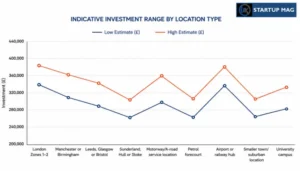
Some third-party franchise publications provide the following indicative planning ranges:
| Location type | Indicative investment | Third-party payback claim |
| London Zones 1–2 | £340,000–£390,000 | 2–3 years |
| Manchester or Birmingham | £310,000–£370,000 | 2–3 years |
| Leeds, Glasgow or Bristol | £285,000–£345,000 | Around 3 years |
| Sunderland, Hull or Stoke | £260,000–£300,000 | 3–4 years |
| Motorway/A-road service location | £290,000–£360,000 | 2–3 years |
| Petrol forecourt | £260,000–£310,000 | 2–4 years |
| Airport or railway hub | £330,000–£390,000 | 2–3 years |
| Smaller town/suburban location | £260,000–£300,000 | 3–4 years |
| University campus | £275,000–£330,000 | Around 3 years |
These are not Greggs-issued cost or return forecasts. In particular, the payback periods should be treated cautiously because Greggs does not publish franchisee-level profit-and-loss accounts that verify a standard two-, three- or four-year return.
Location should instead be assessed through projected transactions, average spend, rent, labour, opening hours, business rates, delivery demand, competition and financing costs.
What Ongoing Greggs Franchise Fees Could Apply?
Initial capital expenditure is only the beginning.
Several third-party franchise sources quote a royalty of approximately 6% of gross sales and an additional marketing or advertising contribution of around 2%.
A separate training or support charge of roughly £5,000 to £7,500 is also commonly referenced.
Greggs does not currently publish those percentages as universal commercial terms on its public corporate franchise pages. They should therefore be treated as estimates until confirmed directly in a franchise or development agreement.
Operators should also budget for costs that can have a greater impact on profitability than the headline franchise charge, including wages, employer National Insurance, rent, business rates, utilities, repairs, insurance, food waste, cleaning, security, delivery costs and debt repayments.
Even a business generating strong sales can produce a disappointing return if occupancy and labour costs are poorly controlled.
Who Is Likely to Qualify for a Greggs Franchise?
Online franchise publications frequently state that Greggs candidates require at least £250,000 in net worth and £100,000 of liquid capital.
Some also claim that Greggs expects potential partners to develop 10 or more locations rather than one individual store.
Those numbers have become widely repeated, but they should not be presented as official Greggs rules because the company does not currently publish those thresholds on its corporate franchise information.
What is much clearer from the way Greggs has built its franchise network is the type of capability a serious partner is likely to need:
- A strong record of operating retail, hospitality, travel or forecourt businesses
- Enough capital to fund development and absorb trading fluctuations
- Access to suitable commercial locations
- A management structure capable of operating several sites
- Experience recruiting and managing large frontline teams
- Reliable financial controls and reporting
- Ability to maintain brand, food-safety and customer-service standards
- Capacity for further expansion rather than dependence on a single unit
This makes Greggs considerably less accessible to a first-time owner-operator than many conventional franchise opportunities.
What Does Greggs’ 2026 Expansion Tell Potential Franchise Partners?
Greggs ended 2025 with 2,739 shops, of which 602 were franchised. Expansion continued during 2026, reaching 2,759 shops by early May and 2,773 by 27 June, including 627 franchise shops.
During the first half of 2026, 65 new shops opened, including 27 franchise locations, while closures and relocations resulted in 34 net openings. Greggs expects approximately 100 to 110 net new shops during 2026.
The company’s strategy is also becoming broader than opening conventional high-street stores.
Smaller Bitesize Greggs locations and the new self-service Greggs Express format are being tested, while travel hubs remain an important part of the franchise network.
That gives established partners more ways to develop the brand across locations that might not accommodate a standard full-size shop.
The customer proposition has become increasingly digital too. The Greggs App was scanned in 31% of transactions in company-managed shops during the first half of 2026, up from 25.7% a year earlier.
Greggs was also ranked the UK’s number-one breakfast food-to-go brand in Circana data covering 2025.
Earlier market data had put its breakfast share at approximately 19.6%, which explains why some franchise articles still describe it as having roughly 20% of the breakfast market.
How Strong Is Greggs as a Business?
Brand scale does not guarantee that an individual franchise investment will succeed, but Greggs’ corporate growth helps explain the demand for its locations.
Sales passed £2 billion for the first time in 2024, when 226 new shops were opened and the estate finished the year at 2,618 sites.
For the first half of 2026, Greggs reported £1.10 billion of total sales, an increase of 7.2% year on year. Franchise-shop like-for-like sales increased 1.3%.
A historical third-party analysis published in 2024 calculated approximately 9% compound annual revenue growth and 15.3% operating-income CAGR over the preceding decade to FY2023.
Those figures illustrate the longer-term growth of the overall company, but they should not be interpreted as the growth or return an individual franchisee can expect.
What Legal and Compliance Costs Need to Be Included?
A Greggs franchise is not simply a brand licence and shop fit-out. A food retail operator must also meet a range of legal, property, employment and regulatory obligations.
Food Registration and Hygiene
A food business generally needs to register its premises with the appropriate local authority at least 28 days before trading. Operators also need suitable food-safety procedures, allergen controls and hygiene systems.
Some unofficial Greggs franchise publications claim operators are expected to maintain a minimum four-star Food Hygiene Rating Scheme score.
That may be a sensible operating benchmark, but Greggs does not publicly confirm it as a universal franchise condition, and it should not be confused with the legal rules governing food businesses.
Employment Responsibilities
A franchise operator employing staff becomes responsible for employment contracts, wages, working time, holiday entitlement, pension duties and other employment obligations.
UK employers must generally carry employers’ liability insurance of at least £5 million through an authorised insurer.
Business Rates and Property Costs
Commercial property costs can materially change store economics. Rateable value, relief eligibility and the type of property all affect the amount payable, making it important to understand how to calculate business rates before committing to a site.
Investors also need to examine the lease length, rent reviews, repairing obligations, service charges, break clauses and responsibilities for alterations.
Data Protection
Digital ordering, customer information, staff records and connected systems can introduce UK GDPR and other data-protection responsibilities.
The exact roles of Greggs and a franchise operator in relation to loyalty-app data would depend on the contractual and technical arrangements rather than automatically falling to the franchisee.
Insurance
Depending on the business and franchise agreement, cover may include employers’ liability, public liability, property, business interruption, stock, equipment and product-related risks.
Professional advice from a solicitor familiar with franchise agreements and an accountant experienced in multi-site retail can be particularly valuable before signing.
Can You Finance a Greggs Franchise?
Potential investors do not necessarily need to fund every pound of development entirely from cash, but substantial equity is likely to be important for a project of this size.
Possible funding structures include commercial bank lending, specialist franchise finance, asset finance for qualifying equipment, property finance where relevant, investor equity and working-capital facilities.
A multi-site development strategy requires particular care because the first location may still be building sales when capital is needed for the second or third.
Before taking on debt, an investor should model at least three scenarios: expected trading, weaker-than-expected sales and significant cost inflation.
The model should include debt interest, rent, labour, royalties, marketing contributions, tax, repairs and sufficient working capital.
A lender approving a loan does not prove that the franchise economics are attractive. The underlying business still needs enough free cash flow to service the debt and provide an acceptable return on the investor’s equity.
How Does Greggs Compare With Other Major Food Franchises?
Greggs is unusual because the headline investment can look lower than some international fast-food brands while access to the opportunity is far more selective.
| Brand | Indicative UK investment/financial position | Ongoing brand fees | Open to ordinary new UK applicants? |
| Greggs | £260k–£390k commonly quoted; not officially published | ~6% royalty + ~2% marketing are third-party estimates | Highly selective; established partners favoured |
| McDonald’s | Around £900k–£1.5m for restaurant rights and equipment under current published information | 5% royalty + 4.3% marketing, plus rent | Yes, subject to selection |
| Subway | Investment currently starts at around £180k; £15k initial franchise fee | 8% franchise fee + 4.5% marketing | Yes |
| Domino’s | Site-dependent; £120k–£350k has been quoted as an indicative UK range | Ongoing royalty and advertising charges | Franchise model available, subject to eligibility |
| KFC | No standard UK project cost publicly stated; applicants are expected to demonstrate substantial financial capacity | Commercial terms depend on agreement | Yes, mainly experienced growth operators |
| Costa Coffee | Cost varies considerably by format; many locations operate through partnership/licensing models | Agreement dependent | Not a straightforward open single-store franchise |
| Starbucks | Primarily company-operated and licensed-store arrangements in the UK | Agreement dependent | No conventional public single-store franchise route |
McDonald’s, for example, currently states that rights and equipment for a first restaurant can cost approximately £900,000 to £1.5 million and expects candidates to bring around £300,000 in unencumbered funds.
Someone comparing the two models can examine the current McDonald’s franchise cost in the UK in more detail.
Subway’s published UK information gives a lower entry point, with investment starting at approximately £180,000, an £15,000 franchise fee, an 8% ongoing franchise fee and a 4.5% advertising contribution.
KFC takes another approach.
Rather than publishing one standard construction budget, its UK recruitment material looks for experienced operators with substantial financial resources, including around £5 million of assets and £2 million in liquid capital.
For investors considering other branded food businesses, the economics of Domino’s Pizza franchise cost and Cake Box franchise cost illustrate how widely capital requirements and operating structures can vary.
Could Greggs Be Easier to Enter Than Wingstop?
Not necessarily. The two businesses demonstrate why simply comparing headline franchise costs can be misleading.
Wingstop UK operates under a master-franchise structure, with Lemon Pepper Holdings holding the UK and Ireland development rights, and standard UK sub-franchise opportunities are not currently being broadly recruited.
Greggs already operates hundreds of franchised locations, but its network is similarly selective and orientated towards capable strategic operators.
Anyone weighing the brands should therefore compare access to the franchise, not simply the estimated capital requirement. The current position on Wingstop franchise cost provides a useful contrast.
How Profitable Can a Greggs Franchise Be?
There is no reliable public figure for an average Greggs franchisee’s annual net profit.
Claims that a Greggs site routinely produces a specific profit margin, £60,000–£100,000 annual profit or a guaranteed two-to-four-year payback should therefore be approached carefully.
Greggs reports overall corporate performance and franchise-shop sales growth, but that does not reveal the complete economics of an individual franchised location.

A proper store-level model needs to start with:
- Sales: Expected daily transactions × average transaction value × trading days.
- Gross margin: Sales minus food, packaging and other direct product costs.
- Operating costs: Labour, rent, rates, utilities, insurance, repairs, cleaning, waste, security, technology and local operating expenses.
- Franchise charges: Any royalties, marketing contributions, technology charges or other contractual payments confirmed during negotiations.
- Finance and tax: Interest, capital repayments and applicable taxes.
The final return should then be measured against the investor’s own cash contribution, not simply against sales.
A petrol-station operator using an existing site may have completely different economics from a partner developing a new transport-hub store from scratch.
How Would a Greggs Franchise Application Work?
Greggs does not publish a simple consumer-style application journey with a fixed fee and guaranteed sequence.
Its corporate site does, however, provide a dedicated franchise enquiry contact at franchise.enquiries@greggs.co.uk.
For a serious commercial applicant, a realistic process is likely to involve initial contact with the franchise team, presentation of the operator’s business and financial background, discussion of development capability, assessment of potential sites, commercial due diligence, negotiation of the agreement, property and fit-out planning, operational preparation and training before launch.
An applicant approaching Greggs would be better prepared with a credible development proposal rather than simply asking how much one shop costs.
That proposal could include available capital, existing business operations, management experience, proposed territories or location types, potential sites, development timetable and evidence that the organisation can operate consistently at scale.
Is a Greggs Franchise Worth the Investment in 2026?
Greggs has several features that make the business commercially attractive: enormous UK brand awareness, a large existing store estate, leadership in breakfast food-to-go, continuing shop expansion and increasing use of digital loyalty.
However, these strengths do not automatically make Greggs an accessible franchise opportunity.
For most prospective franchisees, the largest obstacle may not be finding £260,000–£390,000.
It may be demonstrating that they have the operating infrastructure, property pipeline, management expertise and financial capacity Greggs expects from a strategic franchise partner.
This makes the opportunity potentially well suited to established forecourt, travel, hospitality and multi-site retail businesses, but far less straightforward for someone whose objective is to purchase a single owner-operated bakery.
Investors should obtain current commercial terms directly from Greggs before relying on any public cost estimate.
Final Thoughts
The Greggs franchise cost is commonly estimated at £260,000 to £390,000, but there is no officially published fixed investment package for independent applicants.
The bigger consideration is Greggs’ selective franchise model, which has been built around experienced organisations capable of operating and developing stores at scale.
With 2,773 shops and 627 franchised locations by June 2026, franchising remains an important part of the company’s expansion.
For established retail, forecourt or travel operators, that could create opportunities as Greggs works towards a potential estate of at least 3,500 UK shops. For individual entrepreneurs seeking one conventional store, however, a more openly recruited franchise may offer a clearer route into business ownership.
Frequently Asked Questions
How much is a Greggs franchise in the UK?
Greggs does not publish a standard franchise price. Third-party sources commonly estimate a total investment of approximately £260,000 to £390,000 per location, although actual development costs can differ substantially.
Does Greggs charge a franchise fee?
Third-party publications commonly quote an initial franchise or entry fee of roughly £25,000 to £45,000. Greggs does not publicly confirm one universal fee, so the amount should be verified directly.
What are the Greggs franchise royalty fees?
Industry sources frequently quote approximately 6% of gross sales as a royalty and 2% as a marketing contribution. These percentages are not currently confirmed by Greggs in publicly available franchise information.
Do I need £250,000 net worth to become a Greggs franchisee?
Several franchise websites quote minimum net worth of £250,000 and liquid capital of £100,000. These should be treated as third-party eligibility estimates because Greggs does not publicly list them as universal requirements.
Can I open just one Greggs franchise?
Greggs’ existing franchise network strongly favours established commercial partners and multi-site operators. Some third-party publications claim candidates are expected to commit to 10 or more shops, although Greggs does not publicly state a universal 10-store minimum.
How many Greggs franchise shops are there?
At 27 June 2026, Greggs operated 2,773 shops in total, including 627 franchised locations.
Who operates Greggs franchise locations?
Confirmed partners have included operators such as Motor Fuel Group and Rontec. Greggs has also partnered with Lagardère Travel Retail for its Tenerife airport location, while industry sources identify other established travel and forecourt businesses within the wider network.
How much profit does a Greggs franchise make?
Greggs does not publish an average franchise-shop net profit figure. Returns depend on sales, rent, wages, property costs, franchise charges, financing, opening hours and operational efficiency, so generic profit or payback estimates should not be treated as guaranteed results.
How do I contact Greggs about franchising?
Greggs publishes a dedicated franchise enquiry email, franchise.enquiries@greggs.co.uk, for commercial franchise enquiries. Applicants should be prepared to demonstrate their financial resources, operating experience and development capability.
Disclaimer: Figures described as estimated or commonly quoted are based on third-party franchise information available in 2026 and are not official Greggs offers, promises or financial forecasts. Corporate store counts and performance figures have been checked against Greggs’ published company updates. Prospective investors should confirm current costs, eligibility criteria, commercial fees and contractual terms directly with Greggs and obtain independent legal and financial advice before committing capital.