What Is a Dark Kitchen? | A Business Model Guide

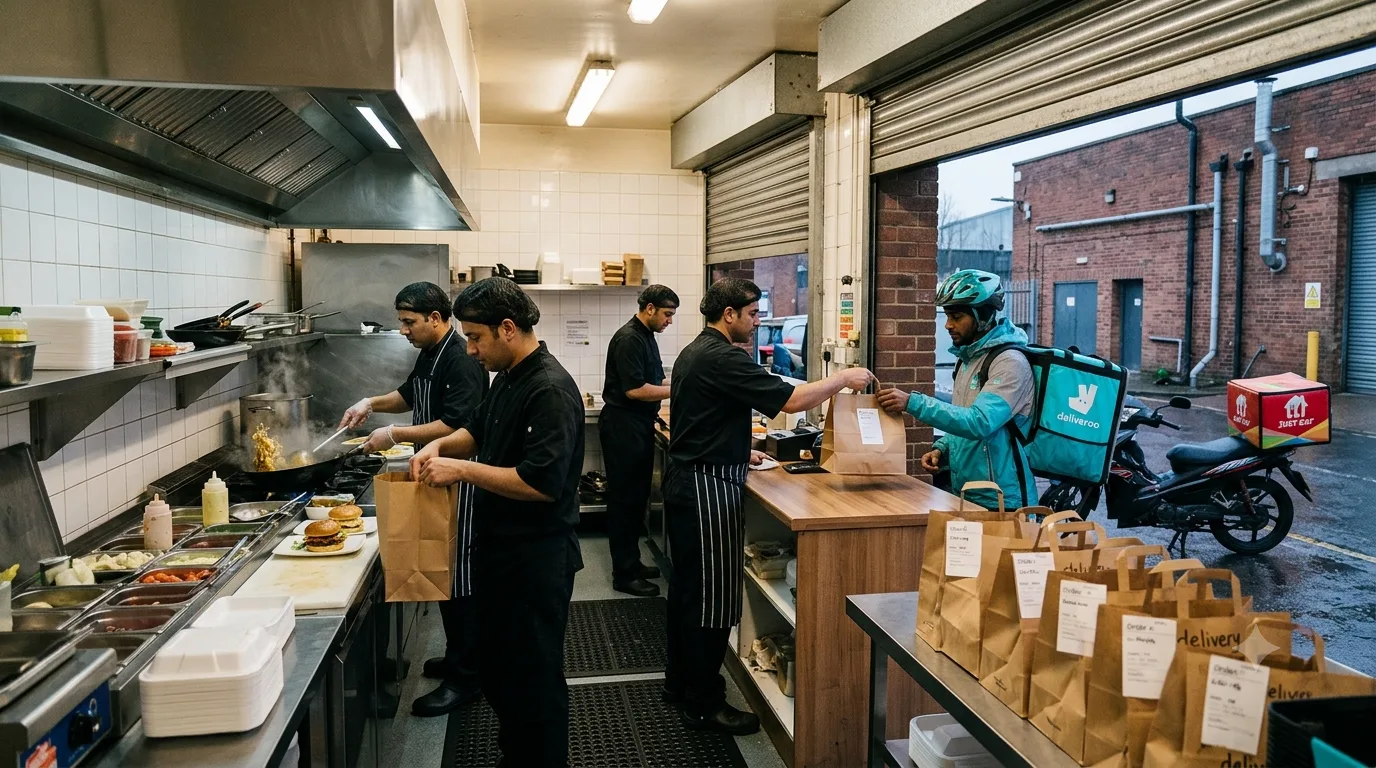
A dark kitchen is a commercial food business designed mainly to prepare meals for delivery rather than serve diners on-site.
Customers usually order through Deliveroo, Uber Eats, Just Eat or the brand’s own website, while the kitchen focuses on cooking, packing and dispatch.
The model is now a meaningful part of the UK delivery market. Sheffield Hallam University reported in October 2025 that dark kitchens made up around 15% of food retailers on the three major delivery platforms in England.
That makes the model more than a pandemic-era trend, but it does not mean every dark kitchen is cheap to launch or easy to make profitable.
How Does a Dark Kitchen Business Model Work?
A dark kitchen removes most customer-facing elements of a conventional restaurant. There may be no dining room, bar, front-of-house team or prominent high-street frontage. Instead, the operation is built around digital orders.
Orders move from an app or website to the kitchen, where staff prepare the food, package it for travel and hand it to a courier.
Customer experience therefore depends heavily on menu photography, app visibility, preparation time, packaging, delivery quality and reviews.
Dark kitchens may operate from industrial units, railway arches, shared commercial kitchens, converted premises or purpose-built delivery hubs. Some facilities can host several brands under one roof.
Dark Kitchen vs Ghost Kitchen vs Cloud Kitchen
The terms are often used interchangeably, with no universal legal distinction. However, they can describe slightly different parts of the same model.
| Term | Practical Meaning |
| Dark Kitchen | Delivery-first food production operation with little or no dine-in service |
| Ghost Kitchen | Often another name for a dark kitchen, sometimes connected to an existing restaurant brand |
| Cloud Kitchen | Commonly a shared or technology-led facility hosting one or more food operators |
| Virtual Restaurant | The online brand customers see, operating from a dark kitchen or another restaurant |
| Commissary Kitchen | Shared commercial kitchen rented by independent food businesses |
The useful distinction is who owns the kitchen, who cooks, how orders arrive, who delivers and how much control the brand keeps over customers.
What Types of Dark Kitchen Models Are There?
- Single-Brand Kitchen: One business operates one delivery brand from a dedicated kitchen, giving greater control but leaving the operator responsible for most overheads.
- Multi-Brand Kitchen: Several virtual brands share staff, equipment and ingredients. It can increase utilisation, although too many brands can create stock and workflow problems.
- Existing Restaurant Delivery Kitchen: An established restaurant uses a separate production site to extend its delivery radius without opening another full restaurant.
- Takeaway-Led Dark Kitchen: The business is mainly delivery-focused but also permits collection.
- Shared Kitchen: Independent food businesses rent units or stations inside a larger facility and share infrastructure such as extraction, waste handling and storage.
- Outsourced Model: A brand outsources some or most production, fulfilment or delivery functions to another operator.
There is also a property-led model where a company divides a large site into individual kitchens and rents them to food brands. Its economics depend more on occupancy, tenant churn and property costs than restaurant sales.
How Much Does It Cost to Start a Dark Kitchen in the UK?
There is no single UK startup figure because location, unit size and existing fit-out make a major difference.
Current provider pricing shows the spread. Dephna lists London commercial kitchens from about £2,000 per month plus VAT for around 380 sq ft.
Karma Kitchen currently lists fitted units from £2,600 per month for 170 sq ft to £6,200 per month for 600 sq ft, before metered electricity.
| Cost Area | What to Allow For |
| Premises | Rent, deposit, VAT, service charges and possible lease premium |
| Fit-Out | Extraction, drainage, electrical capacity, gas and ventilation |
| Equipment | Ovens, fryers, refrigeration, prep benches and smallwares |
| Staffing | Chefs, prep staff, management and employer costs |
| Stock | Ingredients, drinks and cleaning materials |
| Packaging | Containers, bags, labels and tamper protection |
| Technology | POS, delivery integrations, direct ordering and reporting |
| Sales | Platform commission, discounts, advertising and photography |
| Compliance | Insurance, waste, pest control and professional fees |
| Working Capital | Cash reserve for the first months of trading |
Some published startup models have used assumptions of £1,000 to £3,000 monthly rent, £2,500 to £3,000 per cooking station, £1,000 or more for installation and lease premiums around £30,000.
These are useful planning examples rather than reliable 2026 averages.
The same caution applies to profit forecasts. One published 15-kitchen property example modelled roughly £465,000 of year-one outgoings followed by around £350,000 profit in year two.
That is a scenario, not a benchmark. Occupancy, lease costs, tenant churn, utilities and fit-out finance can change the result dramatically.
Where Does a Dark Kitchen Make or Lose Money?
The lack of a dining room can reduce some costs, but delivery marketplaces can take a large share of revenue.
Uber Eats currently publishes a 30% UK service fee for orders delivered using its courier network, excluding VAT. Its published self-delivery and pickup rates are lower.
On a £20 order, a 30% platform charge is £6 before food, labour, packaging, rent, utilities, refunds and marketing.
A founder should therefore track contribution margin:
Order Revenue – Food – Packaging – Platform/Payment Costs – Variable Labour = Contribution Margin
That contribution must cover fixed costs before the business makes a profit. Direct ordering can improve customer ownership and reduce reliance on marketplace algorithms, although it brings its own marketing costs.
What Are the Advantages and Disadvantages?
| Advantages | Disadvantages |
| No Dining-Room Requirement | Platform commissions can squeeze margins |
| Can Use Less Visible Locations | Harder to build a brand without footfall |
| Easier to Test Concepts | Heavy reliance on apps and digital marketing |
| Several Brands Can Share Resources | Multiple brands and apps add complexity |
| Potentially Faster Expansion | Packaging and courier performance affect reviews |
| Lower Front-Of-House Staffing | Customers may question transparency and hygiene |
The model can be more flexible than a conventional restaurant, but lower overheads do not mean low risk.
Consumer Trust, Hygiene and Planning Matter More in 2026
Sheffield Hallam research published in July 2026 found that only 25% of consumers surveyed had heard of the term dark kitchen.
The research also highlighted concerns around hygiene, allergen management, transparency and inconsistent regulatory approaches.
That matters when a customer sees a brand on an app but cannot see whether the meal comes from a restaurant, an unmarked industrial unit or a shared kitchen.
Operators can build trust by making food hygiene information, allergen details, contact information and brand ownership easy to find.
Dark kitchens remain food businesses. Operators generally need to register with the relevant local authority at least 28 days before trading.
For food ordered online or by telephone, required allergen information must be available before purchase and again when the food is delivered.
Planning should also be checked before signing a lease. In England, hot food takeaway use where food is mainly consumed off the premises is generally sui generis.
For dark kitchens, the position can depend on the premises’ authorised use, extraction, odours, noise, delivery traffic and operating hours.
Do not assume an industrial unit automatically permits a delivery kitchen. Check with the local planning authority before committing to a major fit-out.
Which Kitchen Providers and Software Can Operators Consider?
Commercial-kitchen names founders may encounter include Foodstars, Karma Kitchen, Dephna and CloudKitchens.
Foodstars has offered kitchens designed for online delivery and food production, while Karma Kitchen and Dephna currently publish commercial-kitchen options in London.
Availability, lease terms, extraction, storage, equipment and rider access should be checked for the exact location.
Technology becomes more important when several brands or platforms operate from one kitchen.Deliverect integrates third-party orders, menus and POS systems and currently uses customised UK pricing.
Flipdish offers direct online ordering, with its website package starting from £49 per month when billed annually. Bistrohub connects marketplaces with POS systems and currently uses custom quote-based pricing.
Technology should reduce missed orders and duplicate entry. Buying a complex system before volume justifies it only adds another fixed cost.
What Do UK Examples Show?
Dishoom currently offers delivery through Deliveroo and has an Editions listing, showing how an established restaurant can extend its delivery operation beyond its dining rooms.
Taster was built as a digital-first food business and currently lists UK brands including Spud Bros Express and Out Fry. Atcha describes itself as a delivery-only South Asian food business operating from an Islington kitchen.
These examples show that a dark kitchen can support an established restaurant, a portfolio of virtual brands or a smaller delivery-first concept.
What Common Dark Kitchen Mistakes Should You Avoid?
- Ignoring Platform Visibility: Rankings, reviews, promotions and preparation performance can affect whether customers see the brand.
- Launching Too Many Menu Items: Large menus create more stock, waste, preparation processes and allergen management.
- Guessing Local Demand: Research competitors, cuisine gaps, price points and delivery times in the actual postcode.
- Managing Inventory Poorly: Multi-brand kitchens work better when ingredients overlap intelligently.
- Relying Entirely on Aggregators: A platform fee, policy or ranking change can materially affect sales.
- Using the Wrong Packaging: Test dishes after a realistic delivery journey and separate hot and cold items where necessary.
- Underinvesting in Food Photography: Accurate images carry more of the selling job when customers never enter the premises.
How Do You Start a Dark Kitchen?
- Research the delivery area and identify a genuine cuisine or price gap.
- Build a delivery-friendly menu with shared ingredients and clear food costs.
- Choose a private, shared, multi-brand or outsourced kitchen model.
- Prepare a business plan covering order value, contribution margin and break-even volume.
- Compare sites on extraction, storage, power, courier access and total cost.
- Confirm planning, food registration, licensing and insurance requirements.
- Select delivery platforms, POS and order-management software.
- Test packaging, preparation times and food quality after delivery.
- Launch within a controlled radius and track reviews, refunds and repeat orders.
- Add brands or locations only when the first operation has repeatable economics.
Can You Raise Investment for a Dark Kitchen?
Yes, particularly when the concept is designed to scale. Funding may come from founders, business finance, existing restaurant cash flow, crowdfunding or equity investment.
The British Business Bank says angel investors typically invest about £5,000 to £500,000 in exchange for a minority stake, commonly around 10% to 25%.
For example, £100,000 invested for 20% implies a £500,000 post-money valuation and £400,000 pre-money valuation. If the company later reached a £1.5 million valuation and the investor still owned 20%, the holding would theoretically be worth £300,000.
That is not a guaranteed return, and later fundraising can dilute ownership.
Investors will normally want evidence of order volume, contribution margins, repeat purchases, customer-acquisition costs, labour efficiency and a credible route to expansion.
Is a Dark Kitchen a Good Business Model?
A dark kitchen can work well for founders who understand delivery economics and want to test or expand food concepts without building a conventional dine-in restaurant.
It is weaker when the plan depends entirely on cheap rent and marketplace orders. Platform fees, labour, packaging and customer acquisition can quickly absorb the apparent property savings.
The strongest model is usually one where the menu travels well, operations are simple, local demand is proven and the business gradually builds direct customer relationships alongside marketplace reach.
Conclusion
Dark kitchens are now an established part of the UK food-delivery economy, but the model is more sophisticated than renting a kitchen and listing a menu on an app. Costs, commissions, food safety, planning, technology and consumer trust all influence success.
For founders, the opportunity is to treat the dark kitchen as a disciplined delivery business: prove demand, understand the margin on every order and scale only when the economics work.
Frequently Asked Questions
What Is a Dark Kitchen in Simple Terms?
A dark kitchen is a commercial kitchen that prepares food mainly for delivery rather than serving customers in a dining area. Orders usually arrive through delivery apps or direct online channels.
Are Dark Kitchens and Ghost Kitchens the Same?
They are commonly used as synonyms. Some businesses use “ghost kitchen” for an existing restaurant brand operating from a second delivery-only site, but the terminology is not standardised.
How Much Does a Dark Kitchen Cost in the UK?
Costs vary widely. Current London kitchen examples start around £2,000 to £2,600 per month, while larger fitted units can exceed £6,000 before electricity and other operating costs.
Do Dark Kitchens Need a Food Hygiene Rating?
They are subject to food hygiene requirements and local-authority inspections like other food businesses. Registration and the hygiene-rating inspection are separate processes.
Do Dark Kitchens Need Planning Permission?
They may do, depending on the premises and proposed use. Operators should confirm the planning position with their local authority before committing to a lease or fit-out.
Can One Dark Kitchen Run Several Brands?
Yes. A multi-brand kitchen can use the same staff and equipment for several virtual restaurants if it can control stock, allergens, preparation times and order flow.
Are Dark Kitchens Profitable?
They can be profitable, but there is no dependable standard margin. Profitability depends on food costs, order value, labour, rent, packaging, delivery commissions and customer-acquisition costs.