Wingstop Franchise Cost: Is It a Smart UK Investment?

The Wingstop franchise cost is not as straightforward for a UK investor as many online figures suggest. Various UK franchise directories have estimated an investment anywhere from roughly £150,000 to £975,000, while other estimates sit between about £310,000 and £855,000.
However, there is an important distinction. Wingstop’s UK and Ireland restaurants are operated through Lemon Pepper Holdings (LPH), the brand’s master franchisee for the region.
Public information does not currently show a standard UK single-store franchise offer comparable with Wingstop’s US programme. Wingstop’s international markets are generally operated through master-franchise arrangements rather than its standard US franchise agreement.
That means a prospective UK investor should not assume that a £300,000 or £500,000 budget automatically gives them the right to open a Wingstop.
The cost figures are still useful for understanding the scale of the business, but investors need to distinguish estimated UK restaurant development costs from the financial requirements attached to an actual franchise agreement.
How Much Does a Wingstop Franchise Cost?
Several different figures appear when researching Wingstop franchise costs, which is one reason the opportunity can be confusing.
| Cost or requirement | Published figure | What investors should know |
| Older UK investment estimates | £150,000–£975,000 | Very broad estimate and not an official current UK quote |
| Other UK directory estimates | Around £310,000–£855,000 | More consistent, but still third-party estimates |
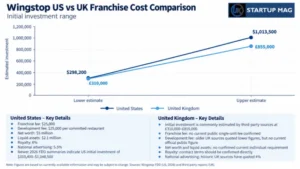
| Current Wingstop US franchise page | $298,200–$1,013,500 | Based on the 2025 FDD shown on Wingstop’s public franchise page |
| 2026 FDD summaries | $310,400–$1,048,500 | More recent US disclosure figures |
| Franchise fee | $25,000 | Current US standard figure |
| Development fee | $25,000 per restaurant committed | Separate from the franchise fee under current US documentation |
| Royalty | 6% of gross sales | Current standard US franchise agreement |
| Advertising fund | 5.5% of gross sales | Current US rate, increased from earlier levels |
Wingstop’s current public franchise material still displays an initial investment of $298,200 to $1,013,500, with a $25,000 development fee and $25,000 franchise fee.
More recent summaries of its April 2026 FDD put the US estimated investment slightly higher at $310,400 to $1,048,500.
These are US figures, not confirmed UK franchise prices.
Older UK-focused sources have quoted franchise fees of approximately £16,000 to £20,000 and development fees around £8,000 to £10,000.
Those numbers should now be treated cautiously because Wingstop’s current public franchise terms have moved substantially.
Why Do UK Wingstop Cost Estimates Vary So Much?
Online estimates currently include approximately £310,000–£615,000, £325,000–£855,000 and £310,000–£835,000, while the previous wider estimate stretched from £150,000 to £975,000.
There are several reasons.
Restaurant size can change fit-out costs dramatically. A compact takeaway-led outlet has different construction, kitchen and furniture requirements from a large dine-in restaurant.
Lease premiums, rent deposits and building condition also vary between London, regional high streets, shopping centres and retail parks.
Different sources may also be converting old US disclosure figures into pounds rather than reporting an actual UK franchise quotation.
Most importantly, the UK operates under a master-franchise structure.
Wingstop’s annual report states that its international markets are generally operated by master franchisees with development obligations for entire countries or regions.
Consequently, the cost of constructing a Wingstop restaurant should not be confused with the cost of acquiring franchise rights in Britain.
Can You Actually Buy a Wingstop Franchise in the UK?
This is the question UK investors should answer before worrying about fit-out costs.
Lemon Pepper Holdings is the master franchisee responsible for Wingstop across the UK and Ireland.
Current information describes the business as holding the regional development rights, while Wingstop’s corporate filings continue to identify LPH as its UK master franchisee.
Therefore, a standard individual UK Wingstop franchise is not publicly advertised in the same way as the US opportunity.
Someone interested in investing should establish directly whether any sub-franchise, development, joint-venture or other partnership opportunity is actually available before arranging finance or committing to premises.
Wingstop does continue to accept franchise enquiries for qualifying markets through its official franchise channel, but territory availability and the structure offered can differ by country.
What Financial Strength Does Wingstop Look For?
Older UK articles frequently quote either £950,000 net worth and £475,000 liquid capital, or the higher figures of approximately £1.2 million net worth and £600,000 liquid capital.
Neither pair should now be presented as a definitive UK requirement without confirmation from Wingstop or its master franchisee.
Wingstop’s current public franchise page is considerably more demanding.
It states that prospective brand partners should have at least $5 million in net worth, including $2.1 million in liquid assets, while also demonstrating experience owning and developing multiple restaurant units.
Some older UK franchise listings also describe a minimum commitment of three restaurants.
Wingstop’s current public material does not state a universal three-store minimum, although it clearly prioritises people with multi-unit restaurant experience and says requirements can differ by market.
This makes Wingstop closer to a multi-unit development opportunity than an entry-level owner-operator franchise.
Wingstop UK vs US Franchise Costs
Comparing the two markets demonstrates why investors should avoid simply converting dollars into pounds.
| Factor | United States | United Kingdom |
| Initial investment | $298,200–$1,013,500 on current public page; newer 2026 FDD summaries indicate $310,400–$1,048,500 | Third-party estimates commonly around £310,000–£855,000 |
| Franchise fee | $25,000 | No current public UK single-unit fee confirmed |
| Development fee | $25,000 per committed restaurant | Older UK sources have quoted lower figures, but no current official UK figure is public |
| Net worth | $5 million | No confirmed current individual UK requirement |
| Liquid assets | $2.1 million | No confirmed current individual UK requirement |
| Royalty | 6% | Contract terms should be confirmed directly |
| National advertising | 5.5% | Historic UK sources have quoted 4% |
| Structure | Individual/multi-unit franchise development | Master-franchise market |
Historic UK estimates may look lower because of exchange rates, different restaurant formats, local property economics and the way the regional master franchise operates.
They should not be interpreted as evidence that opening Wingstop in Britain is automatically cheaper.
Investors comparing other mainstream restaurant opportunities can also benchmark the McDonald’s franchise cost and the Pepe’s franchise cost against Wingstop’s capital requirements.
What Would Wingstop’s Ongoing Fees Cost in Cash Terms?
Percentage fees can look relatively small until they are translated into pounds.
Take a hypothetical restaurant generating £1.25 million of annual gross sales.
Using the older fee structure frequently quoted by UK franchise directories, a 6% royalty would equal £75,000 a year, while a 4% advertising contribution would equal another £50,000.
Combined brand fees would therefore reach approximately £125,000 per year, before rent, wages, food, utilities, delivery commissions, insurance, debt repayments and other operating costs.
There is another reason investors should obtain current terms.
Wingstop’s standard US advertising contribution is now 5.5% rather than 4%. The company’s 2025 annual report confirms a 6% royalty and 5.5% advertising contribution for its standard domestic franchise agreement.
If that 11.5% combined rate were applied purely illustratively to £1.25 million of sales, brand fees would be materially higher than the older £125,000 example.
UK sources also disagree over local advertising. Some describe a separate 1% contribution while others say no additional local contribution is compulsory. That is another contract point that should be verified rather than assumed.
How Profitable Is Wingstop in the UK?
There is evidence that the overall UK and Ireland operation is growing strongly, but that does not justify promising an individual franchisee a particular profit margin.
For the year ending 28 December 2025, Lemon Pepper Holdings reported £216.4 million in revenue and £24.3 million in operating profit. Revenue had risen 73%, while operating profit was up 77.3% year on year.
Those are company-level figures across the master franchise business. They are not the earnings of a typical individual restaurant.
Older articles have quoted UK annual restaurant sales of around £1.25 million to £1.46 million and net profit margins close to 27%.
A prospective investor should not treat the 27% figure as a guaranteed or representative net margin because no current primary-source UK franchise disclosure has been identified that supports such a forecast.
Likewise, claims that an owner should recover their investment within 18 to 24 months are too strong without store-specific evidence.
A realistic profitability model must account for food costs, labour, rent, business rates, utilities, maintenance, delivery platform commissions, finance costs, royalties, marketing contributions and tax.
How Strong Is Wingstop as a Business in 2026?
The wider brand does have considerable scale.
Wingstop ended 2025 with 3,056 restaurants across 17 markets.
Its investor materials reported a three-year system-wide sales CAGR of 25%, 15% adjusted EBITDA growth, approximately 76% cash conversion and a 1,718% total shareholder return since its June 2015 IPO.
Those numbers had already moved again by June 2026. At the end of the second quarter, Wingstop had 3,255 restaurants worldwide, including 527 international franchised restaurants. It opened 102 net new restaurants during the quarter.
There is also a useful warning within those results. US domestic same-store sales fell 7.5% in Q2 2026, even though system-wide sales increased 5.3% as the restaurant network expanded.
That distinction matters. Rapid expansion can increase total system sales even when established restaurants experience softer comparable sales.
The 1,718% shareholder return is impressive, but it is a stock-market return for Wingstop shareholders, not evidence that a restaurant franchisee can expect anything remotely similar.
Wingstop’s UK Expansion Is Now Much Bigger Than It Was
Any figure saying Wingstop operates only 40 or 44 UK locations is outdated.
The UK and Ireland network reached its 100th restaurant in August 2026, with the milestone opening in Inverness. Expansion is no longer confined to central London.
Recent property deals include restaurants at Reading Gate, New Mersey Shopping Park in Speke, Cyfarthfa Shopping Park in Merthyr Tydfil, Glasgow Fort, Central Retail Park in Falkirk, Fort Kinnaird in Edinburgh and Inverness Shopping Park.
Wingstop also has a restaurant at White Rose Shopping Centre in Leeds. For a prospective investor, this demonstrates why location economics can vary substantially.
A London high-street site may carry higher rent, wage and property costs but benefit from dense footfall and delivery demand. Shopping-centre restaurants can involve service charges, operating-hour requirements and landlord fit-out standards.
Retail parks may offer larger spaces and easier customer access while requiring different property and construction expenditure.
There is therefore no meaningful nationwide “average fit-out cost” that can be applied without examining the site.
Could You Finance a Wingstop Investment?
A restaurant requiring several hundred thousand pounds does not necessarily have to be financed entirely in cash, although substantial equity would normally be expected.
UK banks with specialist franchise teams assess established franchise businesses differently from completely unproven start-ups.
British Franchise Association guidance indicates that funding can sometimes reach around 70% of total investment for an established franchise, while a newer franchise may receive closer to 50%.
That leaves the investor typically needing meaningful unborrowed capital of their own.
A lender assessing a large QSR investment is likely to want a detailed business plan, cash-flow forecasts, the franchise or development agreement, full fee schedule, historical brand performance data, evidence of personal capital, site information, projected labour and food costs, working-capital requirements and a realistic repayment stress test.
For Wingstop specifically, an investor should obtain the current franchise pack or applicable disclosure documents before approaching lenders.
Financing an estimated £400,000 restaurant is very different from funding a contractual multi-unit development commitment.
Specialist franchise finance, commercial bank lending and equipment or asset finance may all form part of the funding structure, but debt should not be used to disguise an undercapitalised project.
A smaller-format food retail opportunity can have a very different funding profile; the Cake Box franchise cost provides a useful comparison with a less equipment-intensive restaurant model.
What Training Does Wingstop Provide?
Training information has also changed over time.
Older franchise descriptions have cited approximately 25 consecutive training days in the US, including more than 19 hours of online learning, 30 hours of classroom instruction and 153 hours of restaurant training.
Some UK-focused material has referred to a 17-day programme with at least one day off each week.
Wingstop’s current public franchise material instead describes a four-week training programme at its Global Support Center in Dallas for the brand partner and general manager.
Applicants should therefore rely on the programme specified in their current franchise documentation rather than older directory descriptions.
Support extends beyond training. Wingstop’s franchise material describes assistance with real estate assessment, construction standards, operations and marketing.
How Did Wingstop Become Such a Large Franchise?
Wingstop began in Garland, Texas, in 1994 as a small restaurant focused on buffalo-style chicken wings. Franchising began in 1997.
The business changed hands as it grew. Gemini Investors and other investors acquired a controlling interest in 2003. In 2010, Roark Capital acquired Wingstop from Gemini and another investor.
Wingstop floated on NASDAQ in June 2015 at $19 per share.
Its growth was already attracting attention: Nation’s Restaurant News ranked Wingstop as the third-fastest-growing US restaurant chain in its 2016 Top 100 analysis, based on strong sales and unit expansion.
The restaurant concept historically used aviation-inspired décor alongside its narrow, flavour-led chicken menu, helping it build a distinctive identity rather than competing as a general-purpose fast-food restaurant.
The company announced its move into Britain in 2017, and its first UK flagship restaurant launched on Shaftesbury Avenue in London in 2018.
How Would the Wingstop Franchise Application Process Work?
The precise process depends on the territory and development structure, but an investor should expect several stages rather than simply paying a franchise fee.
| Stage | What happens |
| Initial enquiry | Applicant provides business background, financial resources and preferred territory |
| Financial assessment | Wingstop considers liquidity, net worth and development capability |
| Operational assessment | Multi-unit restaurant and management experience is reviewed |
| Disclosure and due diligence | Applicable franchise documents, fees and obligations are examined |
| Development agreement | Territory and restaurant development obligations are established |
| Site selection | Footfall, demographics, delivery potential and property economics are analysed |
| Design and construction | Restaurant must meet brand specifications |
| Training | Franchisee and management complete required operational training |
| Opening | Marketing and operations teams support launch and ongoing performance |
Older material has sometimes suggested the entire process takes six to nine months, but property acquisition, planning, licensing and construction can change the timetable significantly.
UK applicants should therefore avoid treating that period as guaranteed.
What Are the Main Advantages and Risks?
| Potential advantages | Potential risks |
| Globally recognised and rapidly expanding restaurant brand | High capital requirement |
| Strong UK and international expansion | UK individual franchise availability is unclear |
| Established operating and supply systems | Restaurant property and fit-out costs can be substantial |
| Strong digital and delivery capability | Royalty and marketing fees reduce store-level margin |
| Focused menu may simplify operations | Chicken, labour and energy costs can fluctuate |
| Multi-unit growth potential in available markets | Brand growth does not guarantee individual restaurant profitability |
| Training, construction and operational support | Strict operating standards reduce owner flexibility |
Wingstop reported that digital orders represented 71.6% of system-wide sales during Q2 2026, illustrating how important online ordering and off-premise consumption have become to the model.
Is the Wingstop Franchise Cost Worth It for a UK Investor?
Wingstop is a considerably stronger and larger business than older UK franchise articles suggest.
Its UK and Ireland network has reached 100 restaurants, the wider group now operates more than 3,200 locations, and the UK master franchise business has reported substantial revenue growth.
That makes the brand commercially interesting.
But it does not mean someone with £300,000 or £500,000 can simply apply for a standard UK Wingstop franchise.
The most important consideration in 2026 is the ownership structure. Lemon Pepper Holdings operates the UK and Ireland market as Wingstop’s master franchisee, while Wingstop’s publicly advertised franchise requirements relate primarily to its wider franchise development programme.
For an investor, the smart approach is therefore to confirm territory availability, ownership structure, required restaurant commitment, current fees and required capital directly with the brand before building a financial model.
The Wingstop franchise cost can easily move into a substantial six-figure investment per restaurant, and multi-unit development could push total capital requirements considerably higher.
The brand’s growth provides a strong starting point for due diligence, but location economics, debt costs, operating margins and contractual obligations ultimately determine whether the investment makes commercial sense.
Frequently Asked Questions
How much is a Wingstop franchise in the UK?
There is no current publicly confirmed standard single-unit UK price. Third-party estimates generally range from roughly £310,000 to £855,000, although older estimates extend from £150,000 to £975,000. These figures should not be treated as an official quotation.
What is the current Wingstop franchise fee?
Wingstop’s current public US franchise information lists a $25,000 franchise fee plus a separate $25,000 development fee per restaurant committed. UK terms may differ.
How much liquid capital do you need for Wingstop?
The current public franchise page states a minimum of $5 million net worth with $2.1 million liquid. Older UK articles quote much lower figures, but investors should obtain current territory-specific requirements directly from Wingstop.
Does Wingstop require you to open multiple restaurants?
Wingstop currently looks for applicants with multi-unit restaurant ownership and development experience. Older UK sources have referred to a three-store commitment, but the current public franchise page does not state a universal three-unit minimum.
What royalty does Wingstop charge?
Wingstop’s current standard US franchise agreement charges a 6% royalty on gross sales, together with a 5.5% national advertising contribution. International and UK contractual terms may differ.
How many Wingstop restaurants are there in the UK?
The broader Wingstop UK and Ireland network opened its 100th restaurant in Inverness in August 2026. This replaces older figures suggesting the business had only around 40 to 44 locations.
How much profit does a Wingstop franchise make?
There is no verified current figure showing that a typical UK Wingstop franchise earns a particular net margin. Previous claims of approximately 27% should therefore be treated as estimates rather than guaranteed franchise economics.
Can a UK investor finance a Wingstop restaurant?
Potentially. Specialist UK franchise lenders can finance part of an established franchise investment, but investors normally need meaningful equity of their own, a credible business plan and sufficient cash to withstand slower-than-expected trading.
Where can you apply for a Wingstop franchise?
Prospective investors can check Wingstop’s official franchise opportunities for current requirements and territory availability.
UK applicants should establish whether opportunities are available given the existing master-franchise structure.