
HMRC Interest Rate Changes: What It Means For Startups?

HMRC interest rates can turn a manageable tax bill into a more expensive liability when a business pays late. For startups working with tight cash flow, understanding the latest rates is therefore part of basic financial planning rather than simply a tax technicality.
As of 5 September 2026, the main HMRC late payment interest rate is 7.75%, while the repayment interest rate is 2.75%. Both rates have applied since 9 January 2026.
The latest change followed the Bank of England’s December 2025 decision to reduce Bank Rate from 4% to 3.75%.
The decision was announced on 18 December 2025 following the Monetary Policy Committee meeting ending on 17 December. Bank Rate has subsequently remained at 3.75%, including at the July 2026 meeting.
For businesses, the headline numbers are only part of the picture. Different Corporation Tax payment arrangements can have separate rates, director and employee loans use another HMRC interest measure, and agreeing a payment plan with HMRC does not automatically stop interest.
What Is the Current HMRC Interest Rate?
The main rates applying to many common UK taxes are:
| Interest type | Current rate | Effective from |
| Late payment interest | 7.75% | 9 January 2026 |
| Repayment interest | 2.75% | 9 January 2026 |
| Corporation Tax QIP underpayment interest | 6.25% | 29 December 2025 |
| Corporation Tax QIP overpayment/early payment interest | 3.50% | 29 December 2025 |
| HMRC Official Rate of Interest for beneficial loans | 3.75% | 6 April 2026 |
The 7.75% and 2.75% rates apply across a broad range of mainstream taxes, including Income Tax, National Insurance contributions, Capital Gains Tax and VAT for relevant periods.
Ordinary Corporation Tax balances after their normal due date also generally use the main late-payment framework.
Large companies paying Corporation Tax through quarterly instalments need to pay particular attention because separate debit and credit interest rates apply during the instalment-payment period.
Why Do HMRC Interest Rates Change?
HMRC does not choose the principal late payment and repayment rates independently of wider monetary policy. They are linked by legislation to the Bank of England base rate.
Since 6 April 2025, the standard formulas have been:
- Late payment interest: Bank Rate + 4 percentage points
- Repayment interest: Bank Rate − 1 percentage point, subject to a minimum rate of 0.5%
With Bank Rate currently at 3.75%, this produces:
3.75% + 4% = 7.75% late payment interest
and
3.75% − 1% = 2.75% repayment interest
HMRC increased the late-payment margin from 2.5 percentage points to 4 percentage points from 6 April 2025.
That change explains why late-payment interest jumped from 7% to 8.5% at that point even though the wider direction of Bank Rate was beginning to move down.
How Does the 0.5% Repayment Interest Floor Work?
The repayment rate cannot normally fall below 0.5%.
The floor mattered particularly when the bank rate was extremely low.
If Bank Rate were 1%, for example, Bank Rate minus 1 percentage point would produce 0%, but the minimum floor would keep HMRC repayment interest at 0.5%.
Once the Bank Rate exceeds 1.5%, the normal Bank Rate-minus-1 formula produces more than 0.5%, so the floor no longer affects the calculation.
With the Bank Rate at 3.75%, the current repayment rate is therefore 2.75%.
What Has Changed During the Last 12 Months?
The recent sequence is important because an older article showing an 8% late-payment rate is no longer current.
| Date | Change | Result |
| 7 August 2025 | Bank Rate cut from 4.25% to 4% | HMRC rates subsequently fell. |
| 27 August 2025 | HMRC main rates changed. | 8% late / 3% repayment |
| 18 December 2025 | Bank Rate cut from 4% to 3.75% | Triggered another HMRC reduction |
| 29 December 2025 | Corporation Tax QIP rates changed. | 6.25% debit / 3.50% credit |
| 9 January 2026 | Main HMRC rates changed. | 7.75% late / 2.75% repayment |
| February–July 2026 | Bank Rate held at 3.75% | Main HMRC rates remained unchanged. |
| 17 September 2026 | Next scheduled MPC decision | Potential future rate checkpoint |
The August 2025 Bank Rate reduction was announced on 7 August, when the Bank reduced its rate from 4.25% to 4%. The December decision subsequently reduced it to the current 3.75%.
As of September 2026, the Bank’s next monetary policy announcement is scheduled for 17 September 2026, meaning businesses should check whether any resulting HMRC adjustment follows.
HMRC Interest Rate History From 2022 to 2026
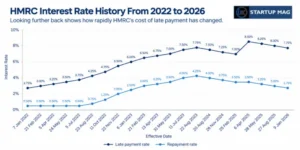
Looking further back shows how rapidly HMRC’s cost of late payment has changed.
| Effective date | Late payment rate | Repayment rate |
| 9 Jan 2026 | 7.75% | 2.75% |
| 27 Aug 2025 | 8.00% | 3.00% |
| 28 May 2025 | 8.25% | 3.25% |
| 6 Apr 2025 | 8.50% | 3.50% |
| 25 Feb 2025 | 7.00% | 3.50% |
| 26 Nov 2024 | 7.25% | 3.75% |
| 20 Aug 2024 | 7.50% | 4.00% |
| 22 Aug 2023 | 7.75% | 4.25% |
| 11 Jul 2023 | 7.50% | 4.00% |
| 31 May 2023 | 7.00% | 3.50% |
| 13 Apr 2023 | 6.75% | 3.25% |
| 21 Feb 2023 | 6.50% | 3.00% |
| 6 Jan 2023 | 6.00% | 2.50% |
| 22 Nov 2022 | 5.50% | 2.00% |
| 11 Oct 2022 | 4.75% | 1.25% |
| 23 Aug 2022 | 4.25% | 0.75% |
| 5 Jul 2022 | 3.75% | 0.50% |
| 24 May 2022 | 3.50% | 0.50% |
| 5 Apr 2022 | 3.25% | 0.50% |
| 21 Feb 2022 | 3.00% | 0.50% |
| 7 Jan 2022 | 2.75% | 0.50% |
HMRC publishes a substantially longer historical series, including rates going back to 2000 for several major taxes.
For startups, the practical lesson is straightforward: an interest assumption that was correct when a tax forecast was prepared can become outdated before the liability is eventually paid.
Do All Taxes Get the Same HMRC Interest Rate?
Not always.
Several mainstream taxes currently share the headline 7.75% late-payment and 2.75% repayment rates, but HMRC maintains separate tables because the legislative treatment can differ between taxes and payment systems.
| Tax or payment type | Current position |
| Income Tax | 7.75% late / 2.75% repayment |
| National Insurance contributions | 7.75% / 2.75% where applicable |
| Capital Gains Tax | 7.75% / 2.75% |
| VAT for periods beginning on or after 1 January 2023 | 7.75% / 2.75% |
| Corporation Tax after normal due date | Generally 7.75% / 2.75% |
| Inheritance Tax | 7.75% / 2.75% |
| Corporation Tax quarterly instalments | Separate 6.25% debit / 3.50% credit rates |
| Certain specialist or historical regimes | Separate rules may apply |
HMRC’s published schedules contain distinct sections for Corporation Tax, Corporation Tax Self Assessment, Inheritance Tax, quarterly instalment payments and other duties.
That means a business should identify the tax and payment regime before assuming the headline rate applies.
How Are Corporation Tax Quarterly Instalments Different?
Scaling businesses can encounter another interest system when they become large enough to pay Corporation Tax through quarterly instalment payments.
For relevant companies, HMRC currently charges 6.25% debit interest on late or insufficient quarterly instalment payments. The rate has applied since 29 December 2025.
HMRC can also pay 3.50% credit interest where qualifying instalments have been paid too early or in excess.
These rates are different from the normal 7.75% late-payment rate.
Debit interest applies during the quarterly instalment period, while ordinary late-payment interest can apply once the normal Corporation Tax due date has passed.
HMRC describes the quarterly-instalment charge as debit interest to distinguish it from standard late-payment interest.
This distinction becomes increasingly relevant as a startup grows into a larger company and its Corporation Tax payment timetable changes.
What Is HMRC’s Official Rate of Interest for Director’s Loans?
The Official Rate of Interest, or ORI, should not be confused with HMRC late-payment interest.
The actual official rate is currently 3.75% from 6 April 2026. HMRC uses it when calculating the taxable benefit associated with certain employment-related loans and some living accommodation.
This can be particularly relevant where a founder or director has an overdrawn director’s loan account or the company provides a low-interest or interest-free loan.
Certain loans with a combined outstanding value of no more than £10,000 throughout the tax year may qualify for an exemption from the beneficial-loan reporting rules, subject to the conditions.
HMRC now reviews the ORI quarterly, with potential changes taking effect on 6 April, 6 July, 6 October and 6 January.
Founders should therefore avoid assuming that the ORI will remain unchanged throughout future tax years.
How Much Does HMRC Late Payment Interest Actually Cost?
A percentage rate becomes much easier to understand when converted into pounds.
Imagine a business has £10,000 of tax outstanding for 60 days while the late-payment rate remains at 7.75%.
A simplified calculation is:
£10,000 × 7.75% × 60 ÷ 365 = approximately £127.40
The business would therefore incur roughly £127.40 in interest over those 60 days.
HMRC calculates Corporation Tax late-payment interest from after the normal due date until the effective date of payment.
If the applicable HMRC rate changes while the debt remains outstanding, the calculation needs to reflect the different rates applying during the relevant periods.
Penalties may also apply separately depending on the tax and circumstances, so interest should not automatically be treated as the total financial consequence of paying late.
The cost also scales quickly. A £50,000 liability outstanding for the same period would produce roughly five times the interest.
Why Do These Rates Matter More for Startups?
A mature business may have significant cash reserves and established tax forecasting systems.
Startups are more likely to experience uneven cash flow, delayed customer payments, rapid hiring costs and unexpected expenditure.
That can create a temptation to use unpaid tax as temporary working capital.
At a 7.75% annual interest rate, however, deliberately delaying tax should not be treated as free financing. A business can also face penalties, collection action and administrative disruption on top of interest.
The gap between HMRC’s late-payment and repayment rates matters too.
HMRC currently charges 7.75% when qualifying tax is paid late but generally pays only 2.75% where qualifying overpayments attract repayment interest.
This makes accurate forecasting important in both directions.
How Can Startups Reduce Their Exposure to HMRC Interest?
The strongest defence is operational rather than reactive.
Businesses should forecast tax liabilities alongside ordinary operating expenses. VAT, PAYE, Corporation Tax and Self Assessment obligations should not appear unexpectedly simply because accounting records have not been updated.
Companies already using digital accounting systems can also use regular reconciliation and tax forecasting to identify liabilities earlier.

Businesses affected by digital reporting requirements should understand how Making Tax Digital works and make sure records are kept sufficiently up to date to support reliable forecasts.
For employers, payroll liabilities need the same attention.
A business hiring staff or beginning to pay directors should establish its PAYE processes early; the practical requirements around PAYE registration for startups become particularly important once regular payroll deductions are being paid to HMRC.
Other sensible steps include keeping a separate tax reserve, reviewing upcoming HMRC deadlines as part of monthly cash-flow planning and investigating discrepancies promptly instead of allowing balances to remain unresolved.
Can a Time to Pay Arrangement Stop HMRC Interest?
No. This is an important distinction.
An HMRC Time to Pay arrangement can allow an eligible taxpayer or business to repay a tax debt through agreed instalments rather than making one immediate payment.
However, HMRC’s own guidance states that applicable interest continues to be charged while the arrangement is running.
For business taxes, HMRC says Time to Pay arrangements should generally be for less than 12 months, although longer periods may exceptionally be considered. The arrangement is based on the taxpayer’s ability to pay.
Time to Pay can still be useful because it may provide a structured way to deal with a genuine cash-flow shortage and reduce the risk of the debt escalating unmanaged.
But it should not be described as an interest-free extension.
A startup considering Time to Pay should contact HMRC as early as possible, understand the total interest expected over the arrangement and ensure future tax liabilities can still be met.
What Happens When HMRC Owes the Business Money?
The position works in the opposite direction when HMRC owes a qualifying repayment.
The headline repayment interest rate is currently 2.75%. However, whether interest is payable, the period for which it runs and the applicable rules depend on the tax involved.
Repayments can arise through VAT, Corporation Tax, Self Assessment and other areas.
Businesses waiting for money already released by HMRC can separately check how the HMRC repayment process works, because repayment processing time and repayment interest are different issues.
For Corporation Tax quarterly instalments, qualifying overpayments or early payments can instead attract the separate 3.50% credit interest rate discussed earlier.
Good accounting therefore involves monitoring both liabilities and credits rather than looking only at tax bills.
Should a Business Borrow Money to Pay HMRC?
There is no universal answer.
If a startup cannot meet a tax liability, founders may compare HMRC’s interest cost with overdrafts, invoice finance or other short-term funding.
The comparison should include far more than the headline interest rate. Arrangement fees, personal guarantees, repayment schedules, early-settlement charges and the effect on future cash flow can materially change the real cost of finance.
Borrowing solely because a lender advertises a rate below 7.75% may therefore be a poor decision if fees make the total cost higher.
Where the problem is temporary, a realistic Time to Pay arrangement may be preferable.
Where the business has a persistent inability to meet tax bills, the problem is more fundamental and should be addressed through cash-flow planning and professional advice rather than repeatedly refinancing HMRC liabilities.
When Could HMRC Interest Rates Change Again?
The immediate date to watch is 17 September 2026, when the Bank of England is scheduled to publish its next Monetary Policy Committee decision.
At the July meeting, the Committee voted 6–3 to maintain the bank rate at 3.75%, with three members preferring an increase to 4%.
That illustrates why businesses should not assume the next movement must be downward.
A change in Bank Rate can ultimately feed through to HMRC’s statutory interest formulas, although HMRC rates do not necessarily change on the same calendar day as the MPC announcement.
For a page targeting hmrc interest rates update, the figures should therefore be reviewed after every Bank of England rate decision and whenever HMRC publishes a new effective date.
Conclusion
The latest HMRC interest rates update leaves the main late-payment rate at 7.75% and the repayment rate at 2.75% as of 5 September 2026.
For most startups, the main priority is preventing tax debt from becoming an expensive form of accidental borrowing. Accurate forecasting, up-to-date accounting records, early action on cash-flow problems and a clear understanding of different tax regimes can all reduce unnecessary interest.
Growing companies should pay particular attention to Corporation Tax quarterly instalments, while founders using director’s loans need to distinguish HMRC’s separate 3.75% Official Rate of Interest from the late-payment rate.
With the next Bank of England decision scheduled for 17 September 2026, these figures should continue to be monitored rather than treated as permanent.
FAQs
What is the current HMRC late payment interest rate?
The main HMRC late payment interest rate is 7.75% from 9 January 2026. It remains the published current rate as of 5 September 2026.
What is HMRC’s current repayment interest rate?
The main repayment interest rate is 2.75% from 9 January 2026. The rate is generally Bank Rate minus one percentage point, subject to a 0.5% minimum floor.
Why is HMRC charging 7.75% when Bank Rate is 3.75%?
Since 6 April 2025, the main late-payment interest formula has been Bank Rate plus four percentage points. A 3.75% Bank Rate therefore produces a 7.75% HMRC rate.
Does HMRC charge interest every day on late tax?
Interest accrues over the period a qualifying tax amount remains unpaid after the relevant interest start date.
For Corporation Tax, HMRC states that late-payment interest runs from after the normal due date until the effective date of payment.
Does Time to Pay freeze HMRC interest?
No. Applicable interest normally continues during a Time to Pay arrangement and should be included when assessing the total amount that will be repaid.
What interest rate applies to Corporation Tax quarterly instalments?
From 29 December 2025, the rate charged on underpaid quarterly instalments is 6.25%, while qualifying overpaid instalments and certain early Corporation Tax payments attract 3.50%.
What is the HMRC Official Rate of Interest for director’s loans?
The actual Official Rate of Interest is currently 3.75% from 6 April 2026. It is relevant to certain beneficial employment-related loans and should not be confused with HMRC’s late-payment interest rate.
When is the next possible HMRC interest rate change?
The Bank of England’s next scheduled monetary policy decision is 17 September 2026. Any Bank Rate change could subsequently affect HMRC rates under the statutory formulas.